"His poem [Ultimo Adios], undated and believed to be written on the day before his execution, was hidden in an alcohol stove and later handed to his family with his few remaining possessions, including the final letters and his last bequests. Within hearing of the Spanish guards he reminded his sisters in English, "There is something inside it," referring to the alcohol stove given by the Pardo de Taveras which was to be returned after his execution, thereby emphasizing the importance of the poem. This instruction was followed by another, "Look in my shoes," in which another item was secreted.
Exhumation of his remains in August, 1898, under American rule, revealed he had been uncoffined, his burial not on sanctified ground granted the 'confessed' faithful, and whatever was in his shoes had disintegrated." - Lineage, Life and Labors of José Rizal, Philippine Patriot by Austin Craig
_________
"Naalala ko pa noon kasalukuyang kaming nakasakay sa bangka nang humulagpos ang isa kong tsinelas. Ang tsinelas ay ang gamit namin sa pagpasok at pagpunta sa mga lakaran kung saan ang bakya na gawa sa kahoy ay hindi nararapat. Mabilis itong inanod sa tubig bago ko nahabol para kunin. Malungkot ako dahil iniisip ko ang aking ina na magagalit dahil sa pagkawala ng aking tsinelas. Tiningnan ako ng nagsasagwan nang kinuha ko ang aking isa pang tsinelas at dali dali kong itinapon sa dagat, kasama ang dasal na mahabol nito ang kapares na tsinelas. "Bakit mo itinapon ang iyong isa pang tsinelas?" tanong sa akin ng kasamahan ko sa bangka.
"Isang tsinelas ang nawala sa akin at walang silbi sa makakakita. Ang isang tsinelas na nasa akin ay wala ring silbi sa akin. Kung sino man ang makakuha ng pares ng tsinelas ay magagamit niya ito sa kaniyang paglakad.
Napatingin ulit sa akin ang mama. Marahil naunawaan niya ang isang batang katulad ko." - From an Anecdote about the boy Jose Rizal
_________
"Q-Do you know Antonio Salazar?A-I know some one with the surname Salazar, who is the owner of Bazaar "Cisne", where I have my shoes made-to-order. I do not know him personally, nor if his name is Antonio. " - From the Transcipt of Rizal's Trial
Of course we now know that "Bazar El Cisne", located at the corner of what are now Carriedo and Rizal Avenue housed a Katipunan-funded printing press. It was set-up by Katipuneros from Kalibo and Capiz, Candido Iban and Francisco del Castillo, who paid for the small printing press with their winnings from a lottery. The press was later moved to Andres Bonifacio's house in Oroquieta Street near Zurbaran and nobody knew what 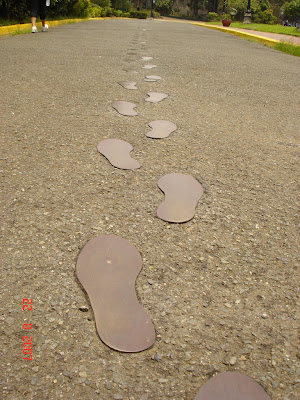 happened to that press after that. The Bazaar's owner, Antonio Salazar on the other hand, is now remembered in Philippine history as one of the “Thirteen Martyrs of Bagumbayan.”
Was it just coincidence that of all places, Jose Rizal chose to have his shoes made at a secret Katipunan headquarters?
_________
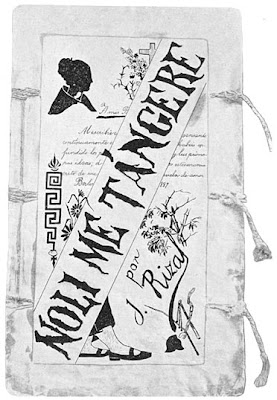 And of course, here we see yet another of Rizal's
not-so-subliminal reference to shoes.
what kind of shoes are those? Why the hairy legs?
whose legs are those?


