Showing posts with label filipino shoes. Show all posts

2008-08-28

Shoes from China spells death to the local shoe-industry

MARIKINA CITY - In a bid to revive the local shoe industry, the Association of Filipinos in Footwear Industries, composed of more than a hundred Filipinos engaged in shoe industry all over the world, vowed to strengthen the Filipino shoe manufacturers and businesses in Marikina.

Juliet Bautista, Nike operations director in China, said the Association's mission is "to serve as a unifying force among all Filipinos in the footwear industries outside and inside the of the Philippines so that we can maintain our competitive advantage in the international arena and sustain this in the next generation of Filipinos to come."

According to Bautista, what the country needs is "innovation." She cited that the country will not be able to cope with global competition if there is no improvement, stressing, "no innovation and they will die."

Identifying the causes of the country's stagnation, Wolverine Worldwide Jojo Dancel rued the lack of support industries in the country.

Dancel said that imported shoes from China swamp the country and local shoes cannot compete.

"To compete with cheap China-made shoes, we sacrifice the quality of our local shoes para lang mabenta (just to make it marketable) but actually nawawala ang integrity in sapatos (the shoe loses its integrity)," he lamented.

full article here >>>


This is a documentary
by GMA Network's Jessica Soho
tackling this issue

video courtesy of GMA Network and Jessica Soho


2008-01-28

walking home from school


"His early education was handled in the private school of Maestro Cabriel of Santa Ana. His mother sought to prepare him for the priesthood, but his father's cousin Doña Carolina sent him to the Ateneo Municipal. His family, being impoverished by his father's vices, could not give the boy the luxury that other students of Spanish parentage had. Young Felipe had to walk to school barefoot and to carry his slippers under his arms, to be worn only in school". - Biography of Felipe R. Calderon on Wikipedia (Calderon is the Father of the Malolos Constitution)


“One memory he retains very well, however, was when his mother brought him to attend the first day of classes in the town’s public elementary school. “I was the only one barefoot,” says Salonga. Six years later, he remained unshod in a class photo taken of the graduating class, which a classmate gave him while he was campaigning for a congressional seat in 1961. He kept this picture to remind him of the hard times he and his family went through early on in his life."- Virgilio Galvez writing about Jovito Salonga (Jovito Salonga was a former Senate President)

When I was a kid, every time I’d nag my parents about buying me a new pair of shoes, they would always tell me that when they were kids, they’d walk to school in nothing but bakyas, and that for their entire high-school life, they only had one pair of shoes. My lola would buy them shoes that were two sizes bigger so that even if they grew, it'll still fit. Then they’d use my uncle who’s a successful businessman as an example, and tell me that my uncle walked to school barefoot so his sisters could buy bakya.

I have to admit that indeed there are many successful individuals in our society today that have had these, if not worse experiences during their childhood. But these aren't isolated cases, nor are experiences like these not happening anymore. Today, young students in the countryside still walk barefoot to school, as their impoverished families could barely feed them let alone buy them slippers or shoes. I myself didn't believe this until I went to visit one school in Laguna with the Knowledge Channel and found out that most of the children there were unshod, and that every school-day, these kids had to walk for thirty minutes just to get to school and another thirty minutes to get back home. Most of them even had to work after school so that they'd have food on the table! It’s just revolting how some politicians could stomach pocketing millions from the public coffers and turn a blind eye to such realities - just imagine how many children those millions could have helped.

2008-01-15

Rizal and his shoes


"His poem [Ultimo Adios], undated and believed to be written on the day before his execution, was hidden in an alcohol stove and later handed to his family with his few remaining possessions, including the final letters and his last bequests. Within hearing of the Spanish guards he reminded his sisters in English, "There is something inside it," referring to the alcohol stove given by the Pardo de Taveras which was to be returned after his execution, thereby emphasizing the importance of the poem. This instruction was followed by another, "Look in my shoes," in which another item was secreted.

Exhumation of his remains in August, 1898, under American rule, revealed he had been uncoffined, his burial not on sanctified ground granted the 'confessed' faithful, and whatever was in his shoes had disintegrated." - Lineage, Life and Labors of José Rizal, Philippine Patriot by Austin Craig

_________


"Naalala ko pa noon kasalukuyang kaming nakasakay sa bangka nang humulagpos ang isa kong tsinelas. Ang tsinelas ay ang gamit namin sa pagpasok at pagpunta sa mga lakaran kung saan ang bakya na gawa sa kahoy ay hindi nararapat. Mabilis itong inanod sa tubig bago ko nahabol para kunin. Malungkot ako dahil iniisip ko ang aking ina na magagalit dahil sa pagkawala ng aking tsinelas. Tiningnan ako ng nagsasagwan nang kinuha ko ang aking isa pang tsinelas at dali dali kong itinapon sa dagat, kasama ang dasal na mahabol nito ang kapares na tsinelas. "Bakit mo itinapon ang iyong isa pang tsinelas?" tanong sa akin ng kasamahan ko sa bangka.

"Isang tsinelas ang nawala sa akin at walang silbi sa makakakita. Ang isang tsinelas na nasa akin ay wala ring silbi sa akin. Kung sino man ang makakuha ng pares ng tsinelas ay magagamit niya ito sa kaniyang paglakad.

Napatingin ulit sa akin ang mama. Marahil naunawaan niya ang isang batang katulad ko." - From an Anecdote about the boy Jose Rizal

_________


"Q-Do you know Antonio Salazar?A-I know some one with the surname Salazar, who is the owner of Bazaar "Cisne", where I have my shoes made-to-order. I do not know him personally, nor if his name is Antonio. " - From the Transcipt of Rizal's Trial

Of course we now know that "Bazar El Cisne", located at the corner of what are now Carriedo and Rizal Avenue housed a Katipunan-funded printing press. It was set-up by Katipuneros from Kalibo and Capiz, Candido Iban and Francisco del Castillo, who paid for the small printing press with their winnings from a lottery. The press was later moved to Andres Bonifacio's house in Oroquieta Street near Zurbaran and nobody knew what happened to that press after that. The Bazaar's owner, Antonio Salazar on the other hand, is now remembered in Philippine history as one of the “Thirteen Martyrs of Bagumbayan.”
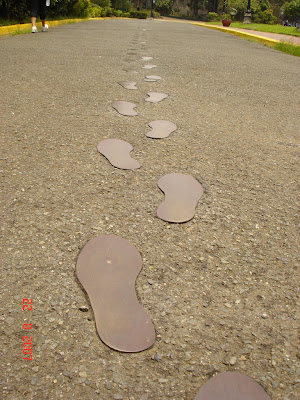

Was it just coincidence that of all places, Jose Rizal chose to have his shoes made at a secret Katipunan headquarters?


Jose Rizal's last path! Originally uploaded by AdamYJ

_________


And of course, here we see yet another of Rizal's
not-so-subliminal reference to shoes.
what kind of shoes are those? Why the hairy legs?
whose legs are those?


Bicol's "Grass" Slippers (Tsinelas na Abaca)

"Mamay thought hard and long about how tho augment our family income to meet our growing expenses. Tlhen one day while she was supervision our palay harvest, she thought of making abaca products.

She first wove and seved abaca slippers for her children. She sent the first crude ones to my brothers in Naga. Then she made abaca hand-bags, wallets, and belts. She experimented with the different dyes and designs and never seemed to be satisfied with waht she had made. Soon her products became objects of beauty and she began to sell them.

Then almost overnight, our house, which was quite big, became an abaca handicraft factory. Our porch became the workshop of Iluminado Fetil, a shoemaker who had worked for years at the Ang Tibay footwear factory, which made the best shoes and slippers many of them custom-built for discriminating buyers. Our sala and dining rooms were crammed full of handlooms and other equepment for weaving. One bedroom became the sewing department. Our kitchen was more oftern used for dying and drying for abaca fibers than for cooking food."

an excerpt from

A BOIENEN INVENTOR
(A history of Bicol's Tsinelas na Abaca)
by Concepcion Claveria-Bulalacao


Image Originally Uploaded by Malou C.

2008-01-14

Syvel's, Escolta


syvel's escolta
Originally uploaded by
mocortez61

"masarap mamili ng gamit dyan... sapatos, damit... lahat-lahat... madalas kaming pumunta nun sa fairmart, fair center, plaza fair, isetann at sm sa sta. cruz na carriedo na ngayon at ang sikat na syvels sa escolta..' - Rodem

"my fond memories of escolta consisted of me and my girlfriends walking (yes walking) from mendiola to escolta to buy shoes from syvels. along the way, we take several stops to browse at shops along recto and avenida, but we always ended up buying at syvel's."
- Photo Cache

The Bakya


bakya mo neneng
Originally uploaded by
laz'andre

"Fashioned from light wood initially with the use of the bandsaw, bakya was afterwards smoothly shaved, and carved with floral, geometric or landscape design, then painted or varnished to a high sheen in the distinctive Paete style. Uppers made of clear plastic or thin rubber were then fastened to the sides with tiny nails ("clavitos") and the bakya was ready for export.

In its heyday (1930s to 1950s), American tourists and soldiers bought bakya as souvenirs for their girlfriends and mothers. But for Filipinos, bakya was the footwear for all seasons. You wore them in water or on land. Bakya was easy to get in and out of, which made it convenient for use by people who wore them on the ground but took them off when climbing upstairs into their houses. My mother, Laureana Cajipe, used to say that you could tell how well-mannered a person was by the way he left behind his bakya before entering the house, "Kabastusan yung iiwanan mo ang bakya mo na nakahakbang!"

When I was growing up in the early 50s, bakya shops were veritable channels of Paete culture where apprentices were trained, families worked closely together, traditional songs and poems were passed on to the young, friendships were forged and romances blossomed. Bakya was Paete's rice-and-fish. The industry that fed, clothed, and sheltered us also taught us responsibility and gave us wisdom. It nurtured our dreams and led us to believe that we would grow up to become good people, just like our parents. And Paete prospered.

- from Marie Cagahastian Pruden's "Romancing the Bakya"

2008-01-13

What was the "shoe" of your Generation?

We take shoes for granted. But what most don’t realize is that shoes have always been there throughout history - in the most significant moments of our country’s history, from the absence of shoes in pre-colonial Philippine society, to the change of that society upon the arrival of the shoe-clad Spanish colonizers who labeled our barefooted forefathers “uncivilized” indios.

Shoes or footwear have inspired early artists, musicians and poets, that’s why our music, poems and folklore are riddled with reference to the lowly “bakya”, “tsinelas” and “sapatos”. In time, shoes have subliminally become an instrument for labeling and separating people in our society according to their economic class, social status and even differing ideologies. The “bakya” for example is now used to label individuals of low cultural taste and social status. The “tsinelas” have for a time been used to categorize the “aktibista”. I remember when I was in elementary school you will not be part of the “in” group if you don’t sport “Sperry” topsiders and later on “blah-blah” shoes. Then in high school, it was black “stick-out-flap” Reeboks that makes you part of the “barkada”. Come to think of it, if you look at pictures and statues of Rizal and Bonifacio, you will notice that Rizal always wears his European shoes and Bonifacio, the plebian, is almost always portrayed barefoot...well, except for the statue in Tutuban of course.

Today, the shoes we wear not only project our personality and our beliefs, it also unjustly brands and labels us the way we discriminately use it to unjustly label others as well. It is really ironic how shoes, in a way have symbolized both the Filipino’s fight for a national identity and the loss of it. This was why I made a documentary about it before, and is why I am doing this web log now.

So I ask you…what was the shoe of your generation?